 Those images are still fresh in my mind; as I sat down to write this memoir.
But words alone cannot make this memoir live, so I decided to add all the photographs that I took at Maheshwar.
I was very firm mentally, to go to Maheshwar, the moment I left for Indore. On my way I went through some of the printouts that I had taken. Lately I had developed a habit of surfing the Internet and collecting information related to the place where I will be going. When I was looking for the possible excursions from Indore, Maheshwar came to my notice. I was very much impressed by those pictures that I saw in the MP tourism’s official website. The grand Ghat struck me the most and immediately my we had an agreement – my inner self and me. I will be going to Maheshwar.
Early morning I checked out of hotel Sayaji Grand and moved our company guesthouse, as my official work was over. I reached the guesthouse, had my breakfast with Rajnish, Dipak, and Mukesh kanchan, while Ramu served us in the best way he can. Ramu was the caretaker cum cook cum …… everything. He had never looked in his master’s eyes, and has no such ideas of doing so in future.
I was told that he came from Nepal, but he is very honest, as all Nepali’s are. That’s the reason that though we don’t have Gorkha’s in India, but we do have the Gorkha Regiment in the Indian Army.
Rajnish and Dipak wanted me to go with them, to the office. I accompanied them to the office and somehow managed to convince them to leave me outside the office. I asked the driver Harish to drop me at Sarvate Bus Stand, from where I can find a bus to Maheshwar.
How I moved
Sarvate Bus Stand to Dhamnod in State Transport Bus (77 kms.)
Dhamnod to Maheshwar in Local Bus (13 kms.)
At the bus stand, some local travel agents told me that there is no direct bus to Maheshwar. So, I will have to go to Dhamnod and from there take another bus for Maheshwar. Took a State Transport Bus to Dhamnod. The journey was horrible; throughout Madhya Pradesh the condition of roads is very bad, but Indore – Dhamnod Route had some really massive potholes and dangerous turns. At some places it was hard to believe that the bus is actually going through a National Highway. After about three hours of impatient drive, I was at Dhamnod. Moved towards a Chai Thela and had a hot cup of tea and some nicotine. As I was about to pay, Chai Wallah said, “Ho Gaya.”
Actually during the course of this three-hour travel I made friendship with an uncle, who was also going to Maheshwar. He felt suffocated and asked for the window seat that I was occupying. I obliged immediately, earlier also when our bus passed Mhow, he took Bhajiya from an outside vendor, and again I did whatever I could have.
In the whole region, I mean Malwa region people have a special love for Bhajiyas, the most popular being the Sev. Sev comes in a whole range of size and taste. Sev sprinkled over Poha (made with rice flakes) and jalebi is everyone’s first choice for breakfast in the whole Malwa Region. The “Poha Penetration” can be gauged from the fact that even in the best hotels, in and around Indore, Poha forms a regular part of the Breakfast Menu.
From Dhamnod, I took another bus for Maheshwar. I reached Maheshwar by 14:15 afternoon. I had two options – one to explore the place alone or take an Auto Rickshaw. I decided to take an Auto Rickshaw as I was already running behind the schedule.
The sight of just two Auto rickshaws and deserted streets made me nervous and in haste, I took Ashfaq for Rs. 100. He named a few places and committed to show all of them. On my way towards the fort, I took a bottle of Chilled water and moved on. Just as reached near the sloppy ramp leading to the fort, the engine had some trouble. Many thoughts came, but after some hit and trials Ashfaq made it move.
As we passed through the main gate, I had a sigh of relief that at last I have made it to one more fort. The fort was a small one with fewer but sound bastions. It occupies the banks of river Narmada, but does have some elevation that adds to its defense. We moved around the palace, and took some photographs. Ashfaq took me to a place from where one can have a simply astounding view of river Narmada, and the adjoining areas. There were many temples along the Narmada Ghat, and one right in the middle of it. Guessing my excited and impatient mood, Ashfaq assured me that we would be going to the same temple later. So, let’s first move into the Palace Complex.

Ashfaq took me inside the Palace, which once was the royal seat of Rani Ahilya Devi.
The palace was made of wood, immediately I inquired why wood? He had no answers to offer. The whole palace was supported with wooded blocks. I was informed that the palace was destroyed some time back in a fire accident and what remains today is a mere sample of what Holkars actually had.
“Holkars might have had I genuine fascination for wood,” I thought. The reason being, in Indore also (next Holkar capital after Maheshwar), Rajwada also faced the same fate. Rajwada was the palatial complex made by the Holkars when they moved to Indore from Maheshwar after the death of Ahilya bai. Rajwada caught fire three times in its lifespan and very little of the original creation has survived.
We moved around the whole palace including the personal temple of Ahilya bai. Ahilya Bai was a Maratha queen who had strong Hindu beliefs. It is said that she ordered her son to be smashed by raging elephants just he has behaved indecently with some ladies. The story very popular in the region is often used to glorify the queen. She used to perform the “Narmada Pujan” every morning before starting the other daily activities. She believed in the woman empowerment, and for the same she promoted weaving of Maheshwari Saris by local women. Even today, these saris are unique in a sense that silk and cotton are mixed while weaving. It was Ahilya bai, who actually planned to shift her capital to Indore, but Indore became the Holkar capital only after death.

We moved towards the temple complex and ghats, just nearby the fort. While I coming down the ramp, I had the first glimpse of Ahilyeshwar temple. The temple had a stark dissimilarity with the palace, we had just seen. It was made entirely in sandstone; even the two dweepa’s near the entrance are made of stone.

I was very satisfied; I got some rewards for the tiresome and lonely journey of about 4 hours. The whole temple complex along with the Cenotaph of Ahilya bai’s son and Ahilyeshwar Ghat are simply great. Sandstone has been used to the extent possible and the quality of workmanship very refined.
The temple has a main entrance that leads to a few steps, which ultimately end up to the raised sanctum. There was a walkway that must have been used for making “parikrama” around the temple. I moved around the whole temple, staring at the huge size of the central spire. In the upper parts, some white marble has also been used to produce some contrasting patterns. Then I moved to the side galleries from where the holy Narmada can be seen. These galleries must have been made for the pilgrims who made their way to Maheshwar in those royal days. Every corner of the complex is in perfect shape and given a water wash will be like a new one. Though in some upper parts, there is some blackening of sandstone because of water leakage.
I took the nearby stairs and reached the top. The views were extraordinary – one side you have the calm stretches of Narmada and on the other, mute and morose structures of the Holkars. The gates were huge and still have the same old “Holkar” woodwork. Having spent a good time in the temple complex and having clicked a good number of photographs in B&W, I moved towards the cenotaph.
The cenotaph too was like poetry in sandstone. Intricate carvings can be seen everywhere. But what drew my and my camera’s attention was a plinth having a number of Carved elephants. May this has something to do with the way Ahilya bai’s son was punished. The structure looked very compact and strong. Nearby there were rest rooms cum changing chambers for pilgrims.
I moved towards the nearby grand gate that leads to the Ahilyeshwar Ghat. The gate is followed by a number of steps in five directions, that end up on a common platform. Vigilant Warriors are ready to take care of any eventuality. “Why that Floodlight?”, I asked myself. Just over the main gate, a floodlight has been fixed may be with right intension of lighting the whole area, but it causes a side effect of disturbing the area aesthetics. From there again, I took steps to descend down to the Narmada Waters. I was simply spellbound by the serene views that Ahilyeshwar Ghat offered.
The calm, quite streams of Narmada dotted with some small boats looks great. Ahilyeshwar Ghat also offers some of the exclusive snapshots of a rural Indian Town…. May be village. I found a number of local people having their bath at the ghats. It was very routine and normal for them. May be they were thinking, “what this stupid is doing here?”, when they saw me. What was a great medieval creation for me was just a bathing Ghat, for them. They have no time for the carvings, Bastions, and Vigilant statues.

I took a small engine powered boat, and moved towards the Baneshwar Temple. Though that fellow was catching flies, and staring at the bathing women at the Ghat, he was not ready to move for less than Rs. 50. I agreed and three of us, me, Ashfaq, and that fellow himself, were on our way. Looking at my camera, he rightly guessed that I am more interested in photography and less in the temple. He placed his boat right in front of the gate for me to take some photographs.
The journey to the temple had some supplements – a classic ultra mild, some water, and cool moisture laden breezes. I moved around the whole temple to have a comprehensive view of the area. I was very excited at the very thought of standing in the middle of Narmade. This was the third point along the length of Narmada that I came in contact with. Earlier I had been to Amarkantak, the staring point of Narmada River and Omkareshwar, another holy pilgrimage center along the Narmada.
I stayed at the temple for some time and took the boat back to Ahilyeshwar Ghat. The Ghat was still busy, this time with a few tourists. I wanted to stay at the Ghat for some more time, but time didn’t permit me to do so. Suddenly I heard some sounds from my empty stomach, and that was a final call. I took out some fruits that I had taken from hotel, and there was some drop in the stomach decibel level.
Ashfaq took me to the other places that actually make Maheshwar a great pilgrimage point for the locals in the Malwa Region. Rajarajeshwara and some more temples nearby are the actual crowd pullers. But, I found them quite pale and of not much historical value. The acrylic paints have been put in layers to hide the underlying sandstone works, and the floors have been covered with slabs of white marble. I waited for some time at the temple, as I was very tired. Took out one more apple from my “SENSA” bag and ate the apple to the extent possible.

While resting there, Ashfaq drew my attention towards the Muslim Community at Maheshwar. Where from they came and why they stayed back at a Hindu Kingdom. After recalling some of my Medieval History Knowledge, I came to a conclusion that they might have moved here or converted to Islam during the reign of Mandu Sultans, who controlled the whole of Malwa for a considerable period of time. And during the next few centuries it was under the Mughals. It was only after the Mughal decline Holkars took control of this region. So, it seems that Maheshwar remained more in Islamic influence and less in Hindu influence.
I decided to call it a day and leave for Dhamnod, but wished to buy back some souvenirs from Maheshwar. I walked into REWA society in the palace complex itself that was run by Holkars till this day. Ashfaq had given me some idea about the cost of Maheshwari saris. I felt that the saris are a bit overprized, so ended up buying two postcards from there. I looked at the backside - © RICHARD HOLKAR. The name Richard itself tells the story of what happened to the Holkar descendents. Like many of the Indian princes, they may have made their way to the overseas lands and stayed back there only. Wherever may be the size, the king always wants to rule, and never wants to be ruled by others.
Came outside the palace complex and move towards the main bazaar for some saris. Found one shop with a board “Credit Cards Accepted.” Moved in, and selected some saris but all of a sudden there was a power failure. I had no cash, and the question was whether I would able to take back the souvenirs. Then, the smart salesman connected the computer UPS to the Charge Machine and it worked. I paid the bill and moved away towards the bus stand. Bus was already packed and ready to start for Dhamnod. Reached Dhamnod safely, enjoying the weather and terrains on the way. Surprising I found some banana plantations on both sides of the road, a deserted school, and many other things.
Just as I reached Dhamnod it started raining, took shelter in a Chai shop. It was a never-ending wait there. I looked for the small board in every bus that passed by, as rain poured down unstoppably. After some time it lost the track, I moved outside from the Chai shop. I was getting desperate, as the sky was turning dark slowly and for me – a complete stranger getting a bus has become the topmost priority. I changed my location and moved near to a mobile shop near the main highway.
“Yes” I got it. At last I got what I was looking for. A bus that has a small board in the front with inscription, “…..SE INDORE.” The seats were already occupied and I had to manage by simply standing on my feet for three and half long hours. It had a whole variety of people, including daily laborers, businessmen, locals, and me. I was very excited and the “Swades” song …yuhi chal chala chal rahi… was going through my mind. When I reached Sarvate bus stand, it was raining and I was doubtful of getting any conveyance to our guesthouse. Fortunately, I found an Autowallah, and straightway headed towards the guesthouse.
I was very tired and satisfied, at the same time. Also the thought of exploring Mandu, the next day was very much in my mind. But, destiny had something else in store; Dipak and Rajnish were waiting for me to plan for the cocktail party. I failed to turn down their request, as they had arranged the party for me only. We went outside in search of some alcoholic beverages, and came back with some alcohol and a few VCD’s.
The whole day turned out to be a great one. Exploring the Holkar stronghold, that has very less admirers today, with its compact fort, woody palace, cast sandstone temples, and surprisingly clean ghats, was like a medieval dream come true. What I liked the most about Maheshwar was the tranquility around the place. No tourist crowds, local people busy with their daily works and the holy Narmada
11th Century GADHI (Padhawali) and 7th Century Batesar Tour
My college Exams were over and I was waiting for the penultimate. As I already had a job offer from HCL Infosystems, I was quite relaxed and so was the mind. In the otherwise monotonous routine life, nothing exciting was in sight. I remember, I was watching Door Darshan that many of us watch only when there is some problem with the cable Signal. The evening news otherwise not of much interest to me, showed some photographs of the recently excavated monuments at Padhawali. I was totally surprised that the monuments are so close and still we haven’t heard of them. Immediately decided to explore the temples the next morning. But, I needed some companions and who else other than Suranjan can serve this purpose. Met him and told him about the discovery of ancient temples of seventh and Eleventh century near Malanpur. He agreed and suggested that we should also take Tanmoy with us. Made a phone call to Tanmoy and the deal was fixed that three of us will move for Padhawali on our trusted cycles, the next morning.
05:30 AM> Started from Surya Vihar Colony with Suranjan (half Hour late than the scheduled departure) on Cycles.
Cycling in the morning hours was not a trouble, in fact the refreshing morning wind was blowing, and the atmosphere still had some cool. I had taken “Luchis” with “Googhni” that mom had prepared. Though I had told her not to do anything, it was not easy to convince her. I personally feel that the Bengali parents are much more possessive about their children as compared to others. I don’t know whether I am right or wrong? Suranjan had packed some sandwiches, which proved out very handy for the breakfast.
05:50 AM> Reached Maharajpura. Waited for Tanmoy at the Chambal gate for about 10 minutes.
06:05 AM> Started for Malanpur. On the way came – Baretha’s Hanuman Mandir and many other (Laxmangarh etc.).
At Malanpur, we tried to inquire the locals about the location of the temples. Some of them looked at us, as if we are going to steal something from there. Some even asked, “why you people want to go there?” we failed to get the correct information and instead of moving left from Malanpur, moved towards Gohad. Just as we were passing through the Malanpur Industrial Area, Tanmoy’s cycle punctured. We started telling him, “hey! Man, you cannot maintain even a cycle properly. After the repair, we sat near the Cycle shop and had sandwiches. Then, we again moved on the same path that is towards Gohad. With repeated queries to the local whom we passed on our way, at last we found one fellow who knew very well about the Padhawali temples. He explained the whole route and possible halts on the way.
07:00 AM> Passed the Malanpur Industrial Area. Tanmoy’s cycle got punctured. Got it repaired at Malanpur and had our Breakfast there. Misled by few stupid, we lost our way and headed towards Gohad.
07:25 AM> Managed to get the location of the destination. We headed towards “Rithoura.” It was a never-ending travel with no hopes for reaching the ultimate point.
The journey from Malanpur to Rithoura Kalan through the industrial area was a less interesting and more exhausting one. We passed through many of the manufacturing units at the industrial area, and reached a railway crossing. Nearby was an office of Central warehousing Corporation, as much I can remember. From there, started the area of Village named “Rithoura Kalan.” We had a small break and smoke. In those days, smoking a full cigarette was a luxury and something he were not used to. We shared a cigarette “Wills – Navy Cut” and enjoyed the last string of tobacco it had. We used to say, “ abbe ghumane ki ho rahi hai” whenever any one had taken more than his allotted puffs.
07:45 AM> At Rithoura, the villagers gave us good idea about the Gadhi and with renewed zeal we started for “Padhawali”. On the way, we found an ancient temple. Stopped there for about 10 minutes. I got some snaps evoking picturesque locations and took a few photographs with my Canon.
On our way towards Padhawali village, what we can spot around were a few cattle, villagers, and some tractors. The road was a classic example of the Indian village road, with more potholes and less covered area. Even the patches were so badly made that it was rather better to cycle on the tracks near the road that pedestrian villagers had created. All of sudden, we had a sigh of relief, “oh! At last something has come.” It was a deserted temple just by the road. The temple was an old one with some devout follower painting it white with limestone. Moved around the temple and relaxed a bit. Suranjan drew our attention to a nearby well, full with water. I maintained a safer distance, as I can’t swim. I thought whether we find Padhawali or not, let’s take some pictures so that I can show them back home. Otherwise he would be laughed off surely for our misadventure, led by me. Having taken the pictures, I thought that at least I have something to say even if we failed to trace out Padhawali.

But, no I was wrong! Just after a few minutes, we were at a junction that had a signboard. Moved towards the Gadhi thought the Padhawali village. The villagers, mostly women were having a suspicious look at us. Where from these fellows have come with cycles and bags on their back? Usually whosoever comes to Gadhi would prefer a sumo, a bus, or a jeep, but on cycles, that was definitely a spirited effort. The whole area started appearing to us, numerous temples mostly Hindu, spread over at least a sq. km. What an experience? Through the dust piled village road we reached the Gadhi entrance and the famous ASI enameled blue plate with “Sanrakshit Smarak” written over it, made a surprise appearance.
07:55 AM> Moved towards Padhawali. There were no signs of any historic monuments. But finally we saw, the “Sanrakshit Smarak” signboard, which gave us a true relief. We felt as we have got the result of about 41 kilometers of cycling.
The gate was open, but no one was there. We kept our cycles in shade and entered the temple through the high-rise stairs, guarded originally by lions on both side. But though one has been put in place the other lion was lying nearby. It was quite evident from the marks on the bastions and walls that the whole temple had survived till this day just because it was buried under soil for centuries. Just the way “Sphinx” had kept his vigil for centuries even being made of soft stone. Sphinx was buried in sand for centuries and because of that only the erosion due to wind has failed to take it over.
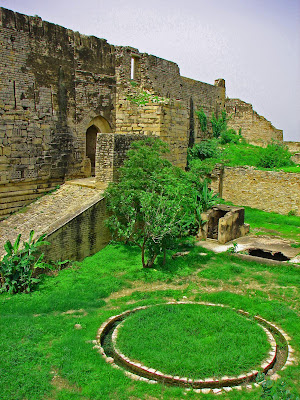
Inside the Gadhi we met the ASI monument attendant. He was very excited and surprised. The reason for that – at last he has got someone to talk to in the otherwise sleepy and deserted area. I can imagine how he would be earning his bread? A lonely area with a feeble not-so-friendly population and the vast emptiness of the ancient temple ruins with very few people visiting them. Alone with the responsibility of taking care of a precious National heritage. Not even knowing what is happening in the nearest town. Just imagine, doesn’t it sounds like “kaala Paani.”
It was like a good first shower after a long dry spell. He personally took us to all the areas of the fort – explored and Unexplored. “Actually earlier only a big temple existed here which was later dismantled to make the fortified smaller one that we have today,” he explained. Though he was not very sure about the origins, he tried to offer something.
He provided his “khatiya” for us to have lunch. He also arranged some fresh water to drink. In the meantime some other people have come. They had some official vehicles that drove us to conclude, “May be IAS officers.”
08:25 AM> Reached the Gadhi. We introduced ourselves as history students of MLB College. The caretaker was very much impressed and showed us all the “Gadhi,” telling us whatever he knew. Again I brought out my camera and took some photographs. After staying for some time there, we had our lunch. After the lunch, we went into the unexplored areas of the Gadhi.
What was straining my brain was, “why so many temples have been erected in such a remotely located place?” the caretaker has told us that in the initial assessment the ASI had put the number of temples at around 1400. Now I was thinking why a place like this? That has no major water bodies nearby, any fertile land. But, the sheer number of temples, small and big confirms that the area must have been a pilgrimage destination in those days. The statues inside the main mandap have an erotic appeal very much same as those at khajuraho. The main deity is seems was Durga, and Tantra might have been practiced.
Moved around the whole area. The bastions with well, the dynamite grinder, water storage tank, and many other things drew our attention. After the wander we had a small break and smoke. We had no plans to move any further, but our main concern was to cycle back to Gwalior, about 25 kilometers.
10:15 AM> We were about to start for Gwalior when one of the local villager told us that the temples at Batesar are a “must see” heritage. No one was ready as our energy cylinders are about to finish. I convinced both of them to go to the Batesar temples about 1 kilometer away from Gadhi.

Just as we moved out of the Gadhi, and went to a nearby hand pump, I asked a local fellow about the nearby Batesar temples. He provided me the push that I needed, but a more hurdle was still there. I made a successful attempt on convincing Suranjan and Tanmoy, and we started to drag our cycles through the piles of dust, that the miners had left towards the Batesar temples. On our way, we saw some foundations. I thought why don’t the ASI people excavate these areas. The miners nearby had started destroying some on them. But, now I can understand that how difficult it is to get the funds. We have a rich history, culture and a numerous monuments scattered all around the Country, but limited resources, and there are issues of larger significance.

Batesar was brilliant. As we moved towards the temples, nothing significant was visible. But, when we made our way through some trees, the temples made a sudden appearance. Most of them had a Shiva Lingam in them and there were about 200 of them in the area. There was a small pond with some water and stone steps. I suppose the pond was from the same time and devotees for a dip must have used it.
Our next halt was a lonely temple placed on high platform. Though the temple was in very bad shape, but it gave of glimpse of what it had been in its primetime. Intricately carved pillars with images of apsaras were an unparalleled visual treat. Stayed there for some time and enjoyed the overall aerial views that the temple offered. Waited for some more time, enjoyed a cigarette and saved a few for the return journey.
11:10 AM> After viewing the Batesar temples took some rest in a lonely placed temple in nearly shattered condition. At about 11:50 AM we started from Batesar. The very thought of driving (rather cycling) back to Gwalior was giving us fear.
Near Rithoura Kalan we met the same official vehicles that we saw at Gadhi. We were resting on a culvert as they passed by. They gave a strange look at us and moved ahead.
13:50 AM> We reached Malanpur and had a chilled bottle of “Cola” which we later found out was not a genuine one.
Again at Malanpur, the same vehicles again crossed us. We decided to have a bottle of Coca Cola.
After some hours of pedaling with tired legs, we reached Maharajpura. It was the “finish mark” for Tanmoy, but for me and Suranjan we had seven more kilometers to go.
14:55 AM> Dropped Tanmoy at the Chambal Gate at Maharajpura. I, and Suranjan then left for Surya Vihar Colony.
15:20 AM> Reached home. At the end of the travel all we had was – pain in all the body and some unforgettable memories of 11th and 7th Century.
Reached home, mom and didi were about to go to some wedding party in the evening. They asked me to accompany them, I said, “no way.” Had a bath and changed. Then, I thought of putting down in words whatever I had seen. Although the whole body was in pain but, still there was a sense of achievement. How many people go there? And how many can dare to go with cycles? Some childish egoistic thoughts kept on coming and going. The whole areas, the temples, the statues, everything that I had seen were moving around.
Part – II
Batesar – Mitawali Tour; 20 Oct 2000
This was my second visit to the Padhawali Area. Though we had covered the Batesar temples earlier, the hilltop temple at Mitawali was a new uncharted one. This may be termed as a much planned one, with more luxuries. We were about to start on Soumi’s scooter – BAJAJ cub, very old model, with every possible foodstuff to eat, a frozen bottle of water (1.5 litres), and a bottle of Gin (White Mischief). I think I missed the cigarettes. It was less of adventure and more of a picnic.
08:00 AM> Started from Pinto Park in Soumi’s scooter. Left for petrol pump, got some fuel and moved towards Maharajpura. All of us – Soumi (DRIVER), Suranjan, and myself – were on the same scooter. Just as we were passing through Maharajpura, we heard some “knocking” sound in the scooter. Suranjan, sitting in the rear, confirmed about something burning. We stopped at a nearby Auto Repair Shop for rectification.
I offered some idiotic explanation linking the knocking sound with the “Octane Number” of fuel. I said that we must have taken fuel with low Octane Number and that’s why this sound. But, Suranjan’s nose registered the problem differently. He alarmed, “something is burning, we better get it rectified, else it would cause trouble on the way”. That mechanic at Maharajpura tried to fool us, and made a comprehensive list of whatever he felt needs replacement.
08:45 AM> The Mechanic found out a lot of faults in the scooter. The shocker bracket and the oil regulator were malfunctioning. Changed those and moved forward. Now, the scooter was going smooth and we were hoping to reach our destination by 09:00 AM.
We asked him to do the bare minimum to make the scooter run smoothly. He did something and we moved ahead. By this time, our concerns regarding the high melting rate of the frozen bottle had already started to bother us.
09:10 AM> But we were wrong. Just as we reached Malanpur Railway Crossing, the scooter stopped. Soumi made some efforts but it didn’t started. We were about 2 kilometers far from Rithoura kalan, where we could hope to get the scooter repaired. There was a unanimous decision to move towards Rithoura.
From the railway Crossing, we walked while Soumi dragged the scooter in the famous “Gwalior Heat”. We were about 2 kilometers short of Rithoura kalan.
10:25 AM> Reached “Rithoura Kalan.” But there was no mechanic, who could do the needful. Someone told us, that only Rahish Khan could do this. We found him and requested him if he can do it for us. Rahish agreed and after about 1 hour, we left for Padhawali, not on legs but on the scooter.
This Rahish khan was initially reluctant to do it and tried to show how busy he is. But on constant pleadings, he agreed to help us. Though Rahish was a cycle mechanic, he was familiar with some basic aspects of motorbikes. He took his own time, applying the principles of “Hit & Trial” while we waited with no other options. The smoke kept on filling the atmosphere at regular intervals.
By this time, water in the bottle has already undergone a transformation of state. It had melted completely, and getting warmer with time. “What will happen to the plan?”
11:45 AM> Reached Gadhi, but we decided to move to Batesar first. Soumi placed his scooter under a tree and we climbed up to a lonely temple of 7th century. We had our lunch* there. Soumi and Suranjan waited in the temple while I climbed up the mountains to reach at the top of it. From there one can have a breath taking view of the whole area. Came back, Soumi took some photographs, and we left for Batesar temples.
Took our all the accessories, and laid some newspapers to sit on. The water has lost its chill; we decided to go ahead with the same. We turned a bit mischievous with WM. Soumi and Suranjan wanted to enjoy the feeling and stayed in there. Meanwhile I climbed up the nearby mountain.

13:45 AM> We were going all around the ruins of the old temples. There was an “amla” tree and we managed to get some amlas from the tree. Some sadhus were there – resting. I and Soumi moved into a sadhu babas temple. And then we climbed up to the top of a temple. Suji took the photograph. Left for the hand pump at the Gadhi for some water.
I don’t know how we made it but that was quite difficult to climb. We did it with ease while Suranjan decided to remain grounded. The temple itself looks as if it will crumble with the slightest of wind, but when we climbed it we found it sound enough to stay for another 10 years, assuming that it will remain untouched by restoration efforts of ASI.

15:30 AM> Reached the main road and moved towards “Mitawali”. There were two temples at Mitawali but one can have a great bird eye view from the Mitawali Paahar. Came back and started for Maharajpura.

Mitawali was very different from Gadhi and Batesar. It looked more like a “vihara” and less like a temple. It has a striking similarity with the Indian Parliament. I am very sure that Lutyen might have had a look at this monument before designing the Parliament.
It has rather simple architecture. A circular lobby with cells for player, each cell has a Shiva lingam in it. In the center, there’s a big Lingam, enclosed in a stupa. (Please have a look at the photographs)


16:20 AM> As we were coming back and we were just about to reach Malanpur, the petrol finished and again the scooter stopped. Somehow we managed to reach the Malanpur petrol pump, got some petrol, and had a cup of tea.
How we reached Malanpur that’s also an interesting story. We decided that two of us will sit on the scooter and the third will push it from back. But, how to be impartial about the distance one has pushed. Since it was an industrial area, there were streetlights at proper intervals, and that served as a reference. Every one will push the scooter with other two idiots on it for a distance of two poles. Then, one of the two sitting on the scooter will get down and push the other two.
Sound like a law of physics or like a protocol of physical experiments. Because of the well-maintained roads, we enjoyed the whole thing.
17:15 AM> We were on the way towards home. Reached Pinto Park safely. Had an “ADDA” in Suji’s home and then came back. But the trip had lacked the excitement, if there wasn’t Soumi’s scooter.
From Malanpur to Surya Vihar, the scooter behaved in a manner that was expected. Gathered for an evening “adda” at the Suranjan’s house. The trip had everything, though we started with more luxurious options, destiny had chosen something else. But, whatever it had kept for us, we enjoyed to maximum possible extent.
Text in BOLD: Original Text as written in Diary (2000) after the Journey.
Text in Normal: Inputs added while writing this blog.
 In Bhopal, there’s a saying – whosoever comes to this place will definitely come back again, at least once. And yes! It did proved right for me. I was on my way to Bhopal, this time to help my boss to go through the power point slides of a Presentation on Quality Assurance and Inspection. The last time I visited this shaggy city was when I came here for my Engineering Counselling, conducted by VYAPAM. That day is still very fresh in my mind. I had no idea, absolutely no ideas what engineering is all about, and which branch should I opt? Just because I liked the third chapter in my physics textbook – Current and electricity, and had no problem in solving numerical problems relating to Kirchhoff’s rule, I opted for electrical engineering. I thought maybe this stream has more friendly people like Ohm and Kirchhoff, and less troublesome like le chatelier, Markonikoff, and others.
Bhopal, what I found is a city in dilemma. A dilemma of whether to bask in its past glory, or to wake up to the challenges of this dynamic world, and modify accordingly. Although Porsche multi-storied shopping malls have just come up, but still what dominates the Bhopal skyline are the minarets of Taj-ul Masjid. The same is true about the mindset people have. I visited a crowded shopping place, with narrow streets, made even narrower by encroaching vendors and casual local, who have no real work. Quite a good number of women can be spotted in burqa. A burqa does not necessarily mean that the women have still not come out from the social stigma.
Looking into its history Bhopal was ruled for a considerable period of time by Begums, although very orthodox ones. In the medieval times initially the Paramaras, lately the Mandu Sultans controlled it.
The Mirzai Khel Dynasty founded by Dost Mohammad Khan, who was entered the service of the Mughal Empire during the reign of Aurangzeb controlled Bhopal during the final imperial years. The clever begums did everything to keep their hold over Bhopal, and at the same time maintaining warm relation with the British. Shahzada Saif Ali khan, a well-known cine star belongs to the same dynasty.
A succession of women rulers – Begums added some spice to the otherwise dull Bhopal’s history. Qudsia Begum (also known as Gohar Begum) started this no so popular trend in 1819. She took over the kingdom after her husband’s death at the tender agre of eighteen years. Her caourage and bravery made up for her illiteracy. The refusal to wear a Purdah, in those days can give you an idea of the courageus Begum. Completely ignoring the male family members she declared that her 2 year old daughter Sikander will follow her as the ruler. Bhopal’s Jama masjid is one of her creations.
Sikandar Begam, like her mother never observed Purdah. She was a well trained warrior and helped the British during the 1857 Sepoy Mutiny. Her successor Shah jahan Begum, shared many common things with Mughal Emperor Shajahan, other than name. she is remembered for a lot of architectural involvements - a city named Shajahanabad, a new palace named Taj Mahal,Ali Manzil, Amir Ganj, Barah Mahal, Benazir Complex, Khawasoura, Mughalpura, Nematpura and Nawab Manzils.
Sulatn jahan Begum, daughter of Shah Jahan Begum took over bhopal after her mother's death. she made a pallace for herself that toady is known as Sadar Manzil and served as headquaters of bhopal Municipal Corporation.Ahmedabad (city namded after her husband), Qaser-e-sultani palace, Noor-us-sabah palace are some of her efforts to beutify bHopal.other tha these acheivements, She was the first president of the All India Conference on Education and first chancellor of the Muslim University of Aligarh.
The peaceful rule of Begums ended with ascession of Nawab Hamidullah, son of Sultan jahan begum in 1926. This impartial and unorthodox rule of Begums gave Bhopal a unique mixed culture. Hindus were entrusted with high profiles, while the fiery pathans acquired a passion for poetry and art.
But, the Gandhian calls of “purna Swaraj” and subsequent independence from British rule was something that they were not ready for. Bhopal was one of the last princely states to join the Indian Union. It was only on 1st May 1949, about two after indepence, finally Bhopal agreed to sign the Instrument of Acccession.
1956, Bhopal was made the capital of the newly created “Madhya Pradesh” – that is Central Province. Earlier during the British times, Dhar enjoyed this statute for quite a long time. A big responsibility was now on Bhopal – to change itself, remodel itself, and most importantly to change the prevailing mindset of the society. All of a sudden there’s an influx of populace, and development of infrastructural facilities. But, somewhere Bhopal felt behind, it could have become the next Hyderabad, or may be like Baroda.
Union Carbide was the firm that gave this city its share of international attention, although at a very high cost. MIC (Methyl isocyanate) was the gas that leaked into the sleepy quarters, killing thousands of people, in sleep.Today, Bhopal has some small industries and a major production site of BHEL (Bharat Heavy Electricals Limited) – Courtesy Nehru.
I reached Bhopal on 24th Feb. 2005 by Bhopal Express, and moved in to Hotel Jehanuma Palace. This was my first introduction to the palace hotels. I was very excited and thought of staying in a royal apartment was something very new for a commoner like myself. The fountains were in full flow and the royal grandeur was pervasive. The whole day passed by with nothing worth mentioning except a visit to Bhojpura in the evening.
Bhojpura has a huge unfinished Shiva temple from the medieval period. “It is the largest Shiva lingam in the whole world,” informed the local pujari, I belief to add some spice to the otherwise morose structure, that stands deserted. He informed that during Shivaratri, it’s even difficult to put your feet. I looked around the temple complex for my areas of interest and moved out.
Walked around the whole hotel, and the swimming pool, just next to my cottage. I don’t know why a strange thought came to my mind - to have a drink in the royal ambience. Enquired about the bar at reception. “Shergar” was a little expensive so I rather made my way to “Tattenham Corner” – a less expensive and more happening place. Why a bar with such a name, wondered myself. Later I found out that Gen. Obaidullah Khan, who build this palace had a special love for horses, and that’s why such names. Shergar was the horse that Sher Shah Suri rode, while driving out Humayun from the Indian sub-continent. And Tattenham is place famous for its racing horses.
After some screwing pegs of desi Indian rum, came out to see off boss on his return journey to Delhi. “Freedom at last” – now I can relish my biryani and thereafter enjoy a sound sleep; I had a full day to spare and Sanchi on my mind.
Next morning woke up late, had breakfast and equipped with didi’s Kyocera Auto focus camera ventured out towards Sanchi. Though of all possible ways to reach there, but just as I walked out the main gate of Jehanuma Palace, one of the Auto Rickshaw Wallah agreed to take me to Sanchi Directly. Well, I had no problem with Auto Rickshaws as they offer more views, are more airy, has enough space to accommodate two/ three persons and most importantly light on your wallet.
Ishrar, my auto Wallah was in his casual attire – a black pathani suit, embroidered with golden threads. As soon as we moved into a nearby petrol filling station, he took out his Khaki Official uniform to avoid any possible confrontations with the traffic officials. We moved through the famous twin lakes – Chota Talab and Bada Talab, the Sadar Manzil and many other monuments from the bygone Begum Era. After a drive of about 45 minutes, we were at the city outskirts.
What to say about the roads in Madhya Pradesh? You have to experience them yourselves. A board showing the State Highway Number is actually a shame for the State Government. It had more of patches and less of smooth surface. It seems as if the road has been completed in patches only. Very high level of dust and a bumpy road drove me to reanalyze my decision to take an Auto Rickshaw. “It would have been better to come by bus,” even Ishrar agreed.
Having passed through sukhi sewanya, Diwanganj we reached Sanchi. On may way I noticed two dead cows whose skins have been taken off. Just as we reached near Sanchi, the stupas made their first mighty appearance. Nearby were colonies of ASI officials. Sanchi has an old Open laboratory for ASI, right from the days of its inception during the imperial days. What we see today at Sanchi is largely because of the painstaking restoration work done by ASI, after the mindless plundering of these stupas by Cunningham and other amateur treasure hunters. Cunningham dismantled Stupa 2; having found some relics he tried his hand on the grand stupa, by driving a shaft right into it at its center. But this time with no rewards.

ASI took the restoration in 1912, under Sir John Marshall. The stones have been kept in place to make the perfect hemispherical shape that they actually resembled once. Sanchi has a special place in Buddhism, even though Buddha himself never came here. There are some contradictions also as none of the major contemporary travelers had talked about it. But, the importance is derived from the fact that these stupas are the oldest surviving Buddhist monuments in the Indian-subcontinent.
Sanchi today has a collection of some really big and some very small stupas, remains of earlier temples, and monasteries from 3rd century B.C. and later periods. This place was groomed a center of learning by the great emperor Ashoka, who converted to Buddhism after the Kalinga war. Took the tickets from the foothill, and moved uphill to the silent stupas.
Entered through the main entrance and after a brief walk, I was standing in front of something that I first saw in my 6th standard social science book. The Sanchi stupas have a special importance in Buddhist stupa and temple architecture. Why stupas? Came the immediate query. What’s wrong with a temple, as in later centuries Buddhist kings have also build temples as done at Bodhgaya? So, what’s so special about this Hemispherical, solid, mound of rubble? There’s no way to the inside, and yes! What decided the size? And how is a stupa more pro-meditation as compared to a temple? My mind was full of questions, and no answer.
Wandered through the whole area for about two and half hours, in bright scorch sunshine. Climbed up the main stupa, and made a parikrama all around. I had a good book on Sanchi by Debala Mitra, but I left it in Delhi, so, there was no means of decoding the jatakas etched on the gateways. The main stupa has four torana or gateways, in all four directions, and two circumambulatory at different elevations. These a circumambulatories were probably used by the Buddhist monks to do the routine parikramas.

Moved to the temple ruins nearby. Only the foundation and some pillars remain today, what used to be great temples. I feel, Sanchi was developed into a pilgrimage center in the later centuries, with Buddhist stupas as well as Hindu temples. This is also a testimony of the tolerant religious nature of those days. Stepping down along the slant, I landed in a Buddhist monastery; took some pictures and moved towards the Stupa 2. On the way, were remains of cellar meant for Buddhist monks. It was all dry and harsh. The trees had already shed their trees and the water bodies started to dry up. The mineral water bottle that I took from the entrance proved quite useful, with nothing else to beat the heat.
Moved around the stupa 2. This place offers a great view of the whole area. A train passed by; I waited for some more time and then decided to call it a day. “What if the mobile phone had not been invented?” came the quest. The security man sitting next to stupa 2 made me to think so. The poor fellow was all alone, in heat with no shade other than a leafless tree, with no real work, and hardly anyone to talk with. The maximum number of tourist visiting Stupa 2 in off-season cannot be more than 10. Now, just imagine how can he kill his time without his sole companion - his mobile phone. “Poor Guy.”

Came back and enjoyed a smoke with Ishrar. Had a close look at the watch, and adding for the return journey time, I decided to go to Islamnagar. After some two hours of journey, we were in Bhopal. Ishrar took the Berasia Highway for Islamnagar. Islamnagar is a place frequently visited by the Bhopalis in the evening as a park. I found a lot of youngsters, enjoying their moments of intimacy in the royal corridors of Chaman Mahal.
Islamnagar is a fertile patch of plain land that had nothing a fort should have. The fortified area has some eroding bastions scattered here and there, in the lush green fields. Even at some places the fortification looks like a weak wall, the crumbling bastion too looked like scaled down versions of other medieval forts. Winning such a weak fort must have been a joke those days.
Moved around the ruins, though some of the part was inaccessible because of renovation works. Chaman Mahal has been restored quite well and gives an idea of the lifestyle of Mirzai Khel Dynasty. Moved around the other palaces, and Hamams.
Asked Ishrar to drop me at Bada Talab that usually has a lot of activity in the evening. I was feeling hungry, as I had taken nothing since the morning breakfast. Moved into a restaurant, took dahi vada, and a steaming cup of tea, followed by some mild puffs of smoke. It is an unmatched venue to witness Bhopal - that once was - in the fading evening light. The towering minarets of the numerous mosques, the yellowish light that gives the lake a golden touch, and the boats on their comeback voyage all add up for a great view to end up the day.
Started for hotel Jehanuma Palace; had chicken biryani for dinner and left hotel for Bhopal Railway Station. While Bhopal offered a great insight into what a princely state looked like and thought about, Sanchi gave an idea of the Buddhist influence in and around India in the ancient days. The remains of Islamnagar stand testimony to the taste and likings of the Mirzai Khel Dynasty whereas Bhojpura tells us about the might of Paramara King Bhoja, who is often remembered in the famous saying, “kaha raja Bhoja kahan gangu teli.”
 My recent visit to Vadodara or Baroda as it is better known, landed me in one of the most prosperous and industrialized states of the Indian Union - Gujarat that eluded me for many years. With this visit of mine I can claim to have visited all the states of Indian Mainland except the north eastern seven sisters. Gujarat, derived from Gujjar Rashtra, is famous not only for its geography but equally so for its culture and people. Gujarat is blessed with fertile fields and that are very congenial for growing Cotton, Groundnut, and other grains. A good number of small and big rivers satisfy the irrigational needs of a farmer. So, risk of relying heavily on the unpredictable Indian Monsoon is somewhat reduced.
Talking about the vibrant Gujrati culture is quite difficult because to understand the many colours and shades that it encompasses one needs more time and attention. However my recent week long stay did provided me a good first hand glance. A typical Gujrati would never stand in queue for a job rather he would start something of his own. It’s in their blood; Gujjus, as they are fondly called, are born entrepreneurs. Gujrati are fun-loving, hard working and good-travelers. They can be spotted everywhere – from Kashmir to Kanyakumari. Gujarat is also known for its flourishing textile industry and indigenous handicrafts.
Before leaving for Vadodara for Pre-despatch Inspection at ABB, Maneja works I had done all the research. Lonely Planet, Dorling Kindersley, Takeo Kamiya, Ahmedabad ASI Guide book and some inputs from wikipedia was just more than sufficient for me. This time also I made full and multi-dimensional use of my official visit. Top on my agenda were – Champaner Pavagarh, Modhera, Patan, Adalaj, Ahmedabad and local Vadodara sites. I was really excited about the whole idea of having a first look at the Gujarat Vavs, the Ahmad Shahi Mosques, and the princely blocks in Vadodara but equally worried about the prevailing atmospheric conditions, terribly hot and humid.
I started my Gujarat Exploration with one of the UNESCO world heritage sites at Champaner-Pavagarh that has immense historical and architectural importance. Champaner-Pavagarh Archeological Park, as it is known today, comprises of settlements of Champaner at the foothills and Pavagarh atop the hill. Ancient ruined fortifications can be seen all around. When Mahmud Begada who was more famous for eating habits than his administrative skills, planned to capture Pavagarh, held by Rajput Kings, he shifted his base to Champaner. After a long seize of 20 months, finally Begada took control of Pavagarh in 1484. The victory was followed by a reconstruction phase which resulted in a building frenzy of massive mosques and Baolis and renaming of Champaner as Muhammadabad. The love story continued with Muhammadabad being crowned as the capital of the Ahmad Shahi Empire. It ended only when Akbar, the mighty mughal emperor, consolidated his empire with the annexation of Gujarat.
After having my breakfast – ICH Style – at Guest House, I left for the Taxi Stand. My idea was to hire a cab for whole day, but the cabbies asked for an exorbitant amount that drove me to decide in favour of an Auto Rickshaw. The deal was struck for Rs. 350/- plus toll taxes. Guessing rightly about my religious affiliations, my Auto Wallah thought that my only interest would be visiting “Kalika Mata Temple” at Pavagarh hill. Just as we speedily past through Champaner, the minarets of Borah Masjid, also known as Seher ki Masjid, made a rocketing appearance. “Stop”, I screamed “I want to have a closer look at these mosques.” He was quite surprised as a Hindu had expressed a desire to visit a ruined and deserted mosque in scorching summer of May.

Leaving him just opposite the fortified township of Champaner, I entered through the arched gateway. The construction was simply massive, both secular and religious. After a few meters of walk, I was at the entrance of Borah Masjid. A few locals were pondering at the gate whether they should waste Rs. 5/- for visiting the mosque. But, I was charged at the very sight of the huge, spacious and lofty Islamic masterpiece although I had to walk a few extra meters to get the entrance tickets. A chat with ASI Officials at the ticket counter provided me with some invaluable local knowledge about exploring the settlement of Champaner.
The basic layout of Borah Masjid is very simple, but sound, with two towering minarets. The façade has been decorated with finely carved panels showing motifs such as tendrils, leaves, flowers etc. inside the mosque, there is a colonnade of pillars that support the high ceiling. It was quite cool and serenading inside, even if the outside temperature was close to 40 degrees – that’s the beauty of the whole architecture. Having done with the photographic part, I spend some time exploring the dark corners. Before bidding adieu to this massive mosque took some more pictures from outside and moved towards the more famous Jami Masjid.
Walking past the lanes that once had a bustling population during the times of Mahmud Begada; I reached the grandest mosque of Champaner – Jami Masjid. Unlike the Borah Masjid, this mosque has a lofty entrance that leads to the main mosque courtyard. The roofless entrance that must have been covered with a dome has steps on either side for moving in. The central Arch offers a great first view of Jami Masjid with two central minarets dominating the skyline and two more scaled down ones at the corners. The architectural details are very much similar to the Borah Masjid, other than the scale and grandeur. The inner decorative panels are richly crafted, even on the ceilings. The central dome, supported by long stone pillars is a bit different from the typical Muslim style. Here, the supporting pillars are placed in an octagonal array that was a common feature in Hindu Buildings. It’s definitely a fusion of Hindu architectural styles of Solanki Dynasty and Islamic influences of the Ahmad Shahi Empire.
Champaner, in its heydays, was a very prosperous settlement. The climate was salubrious, and life booming. Champaner had around ten mosques, other than a dozen of Baolis, and many other community facilities scattered within a small fortified area. But, moving along was certainly not easy in the humid conditions for me and I decided to leave the other monuments for my next visit. Relaxed for a while at the Main entrance of Jami Masjid; Chatted with the monument attendant and offered him a cigarette than he grasped without any delay. “Saab yeh cigarette hamarey yahan nahi milti”, he added. Finishing off my Classic ultra milds stick and clicking a few photographs, I walked backed for my Auto Wallah.
“Bahat time laga diya’ Yahan kuch hai kya dekhne ko?” This was the immediate response of my Auto Wallah. From there we left for the Pavagarh hill through the forested patches with signboards showcasing the local fauna. After a few meters, a ruined gate that once served as one of the outposts for the ancient citadel came in our way. A peek into the history reveals that the hill of Pavagarh actually had four fortifications, at different times. What are left today are badly ruined stray monuments beyond recognition and some crumbling walls, here and there. After the fall of Pavagarh, Champaner took the centre stage, and Pavagarh silently went into oblivion, only to be rediscovered by the devout Hindus in the 20th Century.
Centuries passed by and for Pavagarh and Champaner, fortune fluctuated beyond imagination. Today, it is Pavagarh that’s pulling the entire crowd and very few people go to see Champaner – a UNESCO world heritage site. Actually in recent times, the aggressive Hindu surge in Gujarat has made Pavagarh more famous than Champaner. Pavagarh, what I found, is commercialized place of pilgrimage with nothing special to offer. It has a modern ropeway, roadside restaurants along the narrow streets that lead to the main shrine a top the Pavagarh hill. I did spotted two ancient Jain temples, one just outside the Ropeway exit and other ruined one next to the dried divine pool at Pavagarh Hill. The main shrine “Kalika Mata Temple” is a modern structure of concrete and steel. Bright paint coats have made it more visually appealing for many, but I was quite disappointed. There was nothing really of my interest; absolutely nothing to instigate my imagination to make out a picture of how Pavagarh would have been in its prime. It is the modernity that’s dominant everywhere and antiquity is definitely lost. Took some photographs from the divine summit and decided to call off the day.
Coming down the hill in Swiss-made ropeway cars, I had my last glimpse of the old hill. Some devout pilgrims were also seen taking on the steep slope on the own. Some idiots were also hovering around the many deserted monuments along the hill ascent. The hill looked very much like the one he had seen in Matheran, very steep and old. Came back and started for Vadodara without any delay. It was around 15 00 hrs and hot winds were blowing all over the place. Reached Ellora Park around 16 30 hrs, took some rest and reviewed all that “kalakari” that I had done with my DSC-H1.
Next three days were pretty normal and routine. Early breakfast, followed by a visit to Maneja for official work, some local sightseeing in the evening, and a simple dinner to finish off the day. Amongst the many local temples I visited, EME Temple was one off-track construction. It was designed by one British engineer named Brig AF Eugene with the corps of Electrical and Mechanical Engineers (EME) of Indian Army long back in 1966. He had tried to fuse in all the religious influences to arrive at a structure with Aluminium sheets. Unfortunately, photography was prohibited. Other temple that came in my way was the ISKCON Temple.
On my 4th day at Vadodara, I went to Ajwa-Nimetha, just because of my driver’s persuasion. He said that the area has a big reservoir and some good gardens. That was also a big disappointment just like Pavagarh. The reservoir has been sealed off for casual tourists as the entire water supply of Vadodara is dependent on it and littering, were common among the Indians, can deteriorate the hygienic quality of the water. Finding nothing interesting and shutter provoking, I made use of the Rs. 55/- entrance ticket including the parking charges, by clicking some butterflies and helping others by clicking their romantic poses.
The poor driver thought that I would be interested in the two amusement parks sitting back to back and would appreciate him for bringing me such a marvel. My response was totally different; showing no interest in the artificial parks, I asked him to take me back to Vadodara. On way back, stopped a while at Payal Snack Shop in Alkapuri Shopping area and packed some samosas and local favorite “Patra.” Patra was really good and stuffy – I had simply been bowled over by spicy Gujrati Cuisine.
Day 5 of my Gujarat Tourney was the most exciting and rewarding one. As always, meticulous planning proved to be of great help. Ahmedabad or Amdabad as it is known locally was on my agenda, and mind. Left for Vadodara railway station without breakfast; took the general ticket; taking the flyover reached platform No. 2, where Gujarat Queen was scheduled to come. Took some bhajiya with green chilies for my breakfast and waited for the train. It was crowded as expected; somehow managed to find a seat after some time. Moving through Anand (famous for Operation flood), Nadiad (that reminded me of Sajid Nadiadwala), Mehmadabad, and many other less known stations, I reached Ahmedabad at 10: 25 hrs. By that time the sun had already fired up the atmosphere.
My plan was to visit Jami Masjid first and then work out the plan for visiting other monuments. Came out of railway station and walked a few meters, to reach a chowk. I was looking for an experienced Auto Wallah as most of the Ahmedabad mosques are located in the congested walled city and found one who agreed to drop me at Jami Masjid for Rs 20. “Why do want to go to Jami Masjid? Are you a Mohammedan? “There was a flurry of queries. I made up story – a really good one. “I am student of Architecture and I am making a thesis on mosques. I have been to some of the major Indian mosques like the Jami Masjid in New Delhi, Mecca Masjid in Hyderabad, and many more”, I replied. “And yes! I am a Hindu.” He was shocked and surprised at the same time. We kept on chatting till he dropped me at Ahmad Shah’s Mosque because of a misunderstanding.
Literally, no one was there except the ASI Monument Attendant, and a local mosque attendant. I decided to stick to my fake identity – post graduate student doing thesis work. I made my way into the old and tattered mosque through the central arched entrance. This mosque has the distinction of being one of the oldest and Ahmad Shah’s personal mosque. The minarets had fallen and the carvings had faded out but whatever has survived is sufficient to make you travel back in time. Imagine 1411, A young sultan had just taken over an empire – insecure and unstable. Defending the boundaries and shrugging off the pressure from Delhi Sultanate would have been his immediate worries. And that’s why the mosque is small and simple, showing less pomp and grandeur. Moved around the interiors for some time and took some photographs.
Next on target was a small, dim and minuscule fort that can be overlooked very easily – Bhadra Fort. It is probably the smallest fort I have ever seen. This too popped up in the initial years of Ahmad Shah’s rule and that provides the logic behind its size. I moved around the edifice, full with encroachers all around, to find any approach up to the top, as my guide book suggested, but found none. Satisfying me with just two shots from outside, I said goodbye to Bhadra, the fort, only by name.

“Symbol of Ahmedabad” that’s how it is known. It also finds a place in the logo of one of the most prestigious management institutes of the world – the Indian Institute of Management, Ahmedabad. Stone carving has never achieved this level of perfection in any part of the world. The carvings fine to the extent that at places it’s difficult even to pass fingers through the beautiful Jaali. Looking at the workmanship one is bound to think that the monument that has such masterpieces must be associated with someone very important. Well! Here the case is not exactly the same. Sidi Saiyyid was just an abyssinian slave who served Ahmad Shah. There are a total of ten Jaalis – Four in the rear and two each on either side, serving as windows providing light and air.
Overwhelmed with the fineness, I decided to have a closer look and for that I had to walk a few extra meters to reach the rear side. When I had a closer look at the stone filigree, I was even more amazed. The semi-circular motif known as the tree of life is actually not a single stone but a collection of small rectangular slabs, carved and then put in place to create the visual illusion. So, has this de-rated the masterpiece in any sense, or added to the craftsmen credit. Well! I feel although working with small pieces had definitely reduced the risks involved in carving the whole that needs painstaking sincerity and immense patience. But, it left the craftsmen with an arduous task of first creating each piece and then playing jigsaw puzzle with the pieces. Placing the pieces rightly and matching each piece with the adjoining four plates in every detail, every turn and twist of braches of the tree of life was a real challenge.
The “tree of life” is perfect creation that symbolizes the fine craftsmanship that was prevalent in the medieval times. My ASI Guide book informed me that Ahmedabad, in its prime had around 50 finely crafted mosques and tombs. Ahmedabad lost its importance only when Mahmud Begada, shifted his capital to Champaner. Having quenched my photographic desires and clicking every possible frame of the famed “Jaali” I decided to move towards Adalaj for the other famous things. I took services of an Auto Wallah named Ramesh who readily agreed to show me Adalaj and other places of my interest.
Moving past the crowded streets of old city, I saw many big and small mosques. Although ASI maintains these ageing monuments with great care, Muslims are allowed to come in for mass prayers on Fridays. So, in a way, these mosques are more alive on Fridays – very much like those medieval Ahmad Shahi days. Strolling through the Raigarh Gate, we left the old city and after a few minutes we hit the bridge over famous river Sabarmati. Roads were generally in good condition and traffic decent.
River Sabarmati is more famous for an ashram by the same name that Mahatma Gandhi made on its bank, and less for its irrigational benefits it offers. A power station owned by Torrent, a pharmaceutical giant, sits pretty on the other bank and supplies power to the city of Ahmedabad. The importance that Ahmedabad held as a focal point of industrial activities can be gauged from the fact that it was one of the few places in India that had electricity even in the pre independence days. A flourishing textile industry had earned Ahmedabad a sobriquet of “Manchester of the East”. After a pleasant drive of about an hour, we reached Adalaj.
Well! Have you ever imagined how many forms and shapes can an ordinary well, primarily meant for community use, take? I am sure, you all might have seen, a well somewhere in your surrounding or house. The very basic model has a vertical shaft that goes deeper into the ground, with a pulley arrangement for putting the buckets with ropes, into it for fetching the precious water. One more arrangement that you could have seen may be is – the Baoli, predominantly found in the north Indian states of Rajasthan, Delhi, and Punjab. These Baolis mostly have straight stairs, leading into the lower levels. Some resting space is sometimes provided on the sides, for the long distance caravans to have some rest. Baolis in and around Delhi, follow this routine and simple pattern. One of the interesting varieties of these Baoli can be spotted at Abhaneri, in Dausa District of Rajasthan. Here, you have symmetrically laid steps that go as deeper as seven stories under the ground level. At higher levels one temple can be seen, supporting the popular belief that this Baoli served the dual purpose of a temple and a well. Adalaj opened my eyes to a new species of the “well” family that’s known as Vav.
Vav – Gujarati for well is somewhat different not only in its construction but also for the purpose. Adalaj Vav or Ruda Baoli as it is sometimes called, is more spacious and multi-functional and showcases the architectural experimentations that took place in Gujarat. The descend is gradual and smooth as compared to the sharp descend of the Baolis. The ratio of the horizontal length to the corresponding depth is much more than unity. Intricate carvings adorn the supporting pillars and walls. At the bottom, there are two pools, one meant for taking ritual baths, and the other, for fetching water. So, what could have been the possible uses – anything as simple as fetching water, resting place for long travelers, place for community gatherings like marriages, nodal point for sending and receiving messages just like a post office, a temple and many others beyond my knowledge and imagination?

Today, Gujarat has around 100 vavs – most of them in very bad state of maintenance and a very few like Adalaj Vav in moderately good state. Taking one of the three possible entrances, we walked down to the flat intermediate platform. The octagonal layout of pillars suggested presence of a domed roof some time back. Columns spanning the distance between the pillars are richly crafted with geometrical designs. Four beautifully carved Jharokhas are placed at the four corners of the intermediate landing. Looking down from the intermediate platform one can hardly judge the pervasive nature of artistry and detailing. As you descend down with a close watch the things become more visible – carved niches in the surrounding walls with simple motifs depicting the contemporary lifestyle, the marvelous brackets that support the horizontal slabs.
My walk down the straight stairs from the first landing to the base was full with caution and awe. Caution was associated with the fears of moving ahead in dark and the very scale of construction for an ordinary well created the awfulness. Strolling down 101 steps and passing through the jungle of 270 pillars, I reached the base. At a depth of 30 meters, it was really cool despite the outside temperature touching 45 degrees. At the base there are two pools - an octagonal and a circular one for storing water. Since it was close to noon, the light was pilfering right into the entire depth adding a bright yellowish tinge to the otherwise dull sandstone. A still haze prevalent over the pools because of evaporation of water was adding to the mystery.
Just as I took out my camera and looking for the frames, I young boy named Harsha came to me and asked, “Are you a professional?” “No I am not,” I replied. I stuck to my intro for the day and gave him some fundas about the trabeate architectural styles which he readily accepted. My camera kept on clicking with the slightest provocation, although the need of a tripod and wide angle converter did caused a lot of regret. Having moved around the interiors, I decided to have an outside view. “How can you ever make out by seeing from here that such extraordinary constructions exist underneath?” I asked myself. Staircases on either side of the octagonal shafts drew our attention. Taking the congested spiral stairs that allow movement of only one person, we landed at one level below ground. The views were simply great and the carvings maintained the same high levels.
Adalaj Vav had just ignited such a passion and desire to explore that when one of the small children informed us about one more Vav at Ambapur, I immediately decided to visit the same. Ramesh, proved very handy in finding the way out, as few local people understand and speak Hindi. After a ride of few minutes in the deserted and dusty roads of Ambapur, we reached the Vav. Sitting near a modern temple, this Vav is in a bad state; the pillars have fallen at many places, thick heap of dust has covered the carvings; the arched opening into the round vertical shaft has crumbled. There’s no water in either of the pools – the square one and the round one. Not wasting much time came out and had a chat with two kids resting near the Vav. Next on schedule – one more Vav at Ahmedabad.
After having Masala Dosa as our lunch, we moved to Asarwa to have a closer look at the Dada Harir Vav. Dada Harir Vav has the same architectural pattern as the Adalaj Vav, differing only in two aspects – intricacy and size. This Vav has less space and uses plain pillars for most of the construction. Domed roofs at the entrance and at the side stairs are additional. One more thing that caused a worry was the blackening of the stones. The sandstone looked quite dull, lackluster, and morose. I had actually decided to call off the day, when Ramesh spotted a mosque sitting just behind the Vav.
We started our exploration with an ageing attendant cum imam who had lost not an ounce of zeal and passion for the otherwise neglected and disdained monument. He took us to all the dark and unexplored corners; passing through many - straight and spiral - hidden staircases, he took us right to the dome top. “Paarow, Photo Paar low” he kept on chanting as he showed us around the mosque and the dargah sitting next to it. After clicking a few carving close ups, and having a short discussion with imam, on a rather sensitive subject of communal harmony in our country, we made our way to our next destination – the Jain temple complex of Huthee Singhjee.
This temple, build somewhere around the mid nineteenth century,1848 to be precise, is a true marvel, although an outside glimpse can hardly give an idea about the treasures that lie inside. Ornate marble carvings all around this Jain complex left no doubt about the flawless workmanship prevalent in those days. This temple dedicated to 15th century Jain Tirthankara, Dharmanatha, has a rectangular layout, with high walls all around enclosing the main shrine.
Do look out for those beautifully sculpted figures that adorn the supporting brackets at the entrance. As the fading sun had left the stone floorings terribly hot and the coir mats were just not sufficient to make it walk able, I decided to pack and leave. The frustration created by prohibitory orders about photography inside the temple premises added the extra fuel for my decision. Before bidding my final adieu, I decided to have a parikrama around the whole complex. A book on the temple complex by one of the descendants of Seth Huthee Singhjee at the ticket and publication counter drew my immediate attention. Going through its pages I made up my mind to go for it, but the hefty price tag made me to change my mind. But, I still feel that the book was a good first hand account of the temple history. Anyway, with no regrets, I returned the book and after wasting some time glancing through the picture postcards, told Anandji to move straightway to the bus Stand.

Just as we were moving through the busy streets towards Ahmedabad Bus Stand, one of the many stray mosques with two high-rise minarets drew my attention. The sun was fading by the time and with a massive tree nearby and perfect blue sky in the background, I just can’t stop myself from clicking. The minarets looked very similar to those on my ASI Guidebook cover. I decided to have a closer look, and entered the mosque. Ahmedabad, in it’s hey days, had around 50 beautifully crafted mosques. Thought some these mosques have lost their minarets because of high seismic activity in this zone, but they still stand out in the haphazardly created urban concrete clusters, and most of them are still being visited on Fridays for prayers. I look back into my guide books later informed me that, it was Muhafiz Khan’s Mosque that provoked me for the photo shoot.
On our way to Ahmedabad Bus stand, we stopped briefly for a frozen cup of special lassi in the old city. It was laced with pieces of papaya, cheeku, and some other fruits with traces of cashew, and kishmish. At bus stand, I was welcomed by a long queue of passengers waiting at the ticket counter. Bidding farewell to Anandji after some bargaining I joined them in the queue as we waited for the next bus for Vadodara. While in the Queue, I had a brief chat with a Sales Executive from Bombay who sat next to me in the bus. The drive to Vadodara was unique in many ways. This was my first ride on a National Express Highway. Ahmedabad Vadodara NE-1, as it is known, is the smoothest patch of Indian road that I have ever traveled. Our bus took around two hours to whiz past this distance of about 100 kms.
Secondly it provided me a glimpse into the Gujarat countryside. A window seat was an added advantage with soothing breeze taking away some of the fatigue. Images of Adalaj Vav, Dada Harir Vav, Ambapur Vav, and Ahmedabad kept on coming before my eyes wherever I closed them. When I reached Vadodara, it was already dark; took an Auto Rickshaw and moved to Ellora Park. A refreshing bath, followed by a homely dinner at transit camp left hardly any desires, except for one to glance through my photographic exploits during the day. Relaxing on my bed in the air-conditioned room, and putting my digicam on “Display” mode I gave a closer look at what I have captured and where I missed out. A sense of achievement and a desire to revisit Ahmedabad were high on my mind. Till now I had stuck to my planned schedule; although I had kept aside Patan and Modhera for my next visit, but still I was more than satisfied.
Day 6 of my tour was left for exploring the local monuments of Vadodara, and I did the same. Architecture was high on my priority list. Vadodara remained the seat of Gaekwads, who nurtured their capital with some great architectural creations. Gaekwads took over Vadodara from the mughals who were ailing after the death of Aurangzeb, in 1721. The third battle of Panipat in 1761 somewhat weakened the might of Marathas but Vadodara remained in their hands until Indian independence. Vadodara stepped into modernity with the efforts of one its illustrious ruler, Sayaji Rao Gaekwad, who worked for establishing educational institutions, libraries, Baroda University apart from developing the local textile industry.
Vadodara, today, is a bursting city with all modern facilities, good educational institutions, a booming engineering industry, many imposing imperial mansions from the bygone colonial era, and more importantly people with a great mindset – liberal and friendly. My interests although were restricted to the exquisite architectural works of Charles Mant and R F Chisholm. I started my tourney with Maharaja Sayaji Rao University – Faculty of Arts building.
Sitting pretty in a well manicured slanted lawn, right in the middle of the city, this building designed by Chisholm is real mix of Islamic and Byzantine styles. If you are looking for any local, I mean Hindu or Maratha influences; you may be disappointed, as there are very few. The walls are done with un-plastered brick masonry – fine and neat; green glazed tiles have also been used to break the red monotony. The arches, quite a good number of them, follow an Islamic pattern, very similar to the ones at Alai Darwaja in Qutub Complex. There is an array of circular windows on the dome that allows natural light to come in reducing the electricity needs of the building. A hefty sum of Eight Lakh thirty thousand and one hundred and fifty rupees was spend in the year 1880 to put up this stupendous structure. Sayaji Rao III was the pushing force behind all this building frenzy for a very noble cause of promoting education.

But, what makes this mammoth monument stand apart, among the others build in Indo-Saracenic style by the British Architect is the somewhat dominating dome on the convocation hall. This dome, inspired from the Gol Gumbaz in Bijapur has the distinction of being the second largest dome in India. Although I could not see the lavish interiors but a vintage photograph taken by an unknown British photographer from the Curzon collection can gave me an idea about opulence. After moving around the whole complex and clicking at the same time, I decided to wrap up my gear. “What the hell is he doing here with a camera and ceaseless curiosity in his eyes?” the students roaming there were clueless. Chisholm who designed many other imperial buildings in other parts of India will definitely be remembered for this majestic edifice.
After a short ride in a metered auto rickshaw, I reached the Maharaja Fateh Singh Museum in the palace premises. The area within the palace premises has many insignificant dilapidated edifices, scattered here and there. Moving past some of them, I reached the ticket counter of the museum. Apart from a few classics by Raja Ravi Verma, the museum houses European artifacts such as statues, paintings from less known western artists. Well! Obviously the westerner would never give away their “Mona Lisa” and whatever failed to match their taste landed in the princely statues of India. Wasting no time, I decided to move to the Lukshmi Vilas Palace – the costliest private mansion in India at the time of its completion.
Charles Mant, a contemporary of Chisholm, was bestowed upon the responsibility of designing a palace that obviously shall symbolize the Gaekwad grandeur and more importantly reflect their secular views. For Mant, it meant that he has to create a structure that pleases a Hindu, a Muslim, a Sikh and a Christian in the same way. And even if I am a layman about Architecture, but still I feel, Mant was is a serious trouble. Grandeur, well, looking into the lavish use of Italian marble, Venetian stained glasses, stucco decorations, mosaic murals with Egyptian motives and other European stuff, Mant definitely met his first objective. But, the second hurdle of harmonizing the religious fervors somewhat missed the target. The blending, to my eyes, was not as smooth, as the Gaekwads would have desired.
Looking into the palace layout, it’s quite evident that the first block resembles a Hindu temple, while the next one has a dome, a predominant Islamic feature. The high tower next to the domed Islamic portion reflects alienation towards a Christian Church. While the last block showcases the architectural features of a Gurudwara. The interiors are really lavish, with finely carved balustrades, scintillating chandeliers, gorgeous glasswork, fabulous flooring, and engraved stone panels. The only disappointing thing was prohibition on photography.
A Serenading silence prevailing over the whole palace complex suggested that it no longer finds any royal attention. Few ageing attendants and fewer tourists because of an exorbitant entrance fee of one hundred Indian rupees have left this fine opulent building in disdain. I was taken directly to a hall that houses specimens from the Gaekwad Royal Armory. Some indigenous and mostly western weapons were stacked tightly without much fanfare. The ageing attendant, Mr. Jadhav, tried to instigate a sense of Gaekwad valor by cooking some spicy stories from wars, but, with no success.
After finishing off the escorted trip of the palace interiors with the royal attendant, I moved outside. The photography restriction was no more there and with no further delay I started clicking. While I was busy capturing the Lukshmi Vilas Palace, one of attendants called me, “Aap pehle andar dekh lijiye, baad me nahi dikhayenge.” I made my way to a big hall that was used for mass public gatherings. Our guide drew our attention to the numerous electric lights that were fitted at the ceiling. “Did they have electricity in those days?” the query came immediately to my mind, but I kept it to myself. After glancing through some other western artifacts customized to Indian taste, we moved towards the Naulakhi Baoli.
Naulakhi Baoli erased all my doubts about the electric power requirements of Lukshmi Vilas Palace. “Do you have any idea why this Baoli is named so? Asked Mr. Jadhav, our guide. Well! May be nine lac rupees were spent on making this Baoli. “No, this Baoli was build to provide cooling water supply for a German generator that cost Nine Lacs in those days and catered to all the electric demands of the imported lightings in the palace” informed Mr. Jadhav. Today, this Baoli is in total neglect; some of the supporting blocks have already collapsed and many other are waiting to follow suit. The abandoned reservoir has found some interesting occupants – snakes. After a brief stay of few minutes, we made our way to the Palace.
With permission from Mr. Jadhav, I went on a photo shootout of the palace exteriors after finishing off his routine guided trip. Fusion is the keyword wherever one can see. One more interesting thing that’s worth mentioning is the use of various shades of stones to create a visual impact. The whole idea was to save the costs incurred on painting the palace. A floral motif with red sandstone is perfectly placed to spice up the otherwise boring yellowish façade while a grayish base has been attached to a beautifully carved yellow pillar to make it somewhat contrasting. After clicking a good number of photographs, had a smoke, and left for Sayaji Baug, only after satisfying the vigilant caretaker at the entrance who noted down literally everything that you need to log on a hotel register on my entry. I walked down a few yards to photograph one of the many elaborate gates that once led to the lavish palatial mansion.
This was second trip to Sayaji Baug – enormously popular amongst the locals for an early morning jog, or a casual evening strolls with local snacks thelas offering nearly everything that one may desire. Children who love exploring the many museums it houses can hardly resist a chugging ride in the toy train that encircles this Public Park - designed and planned flawlessly. There’s something for everyone – for grown ups and children with scientific taste, there’s Sardar Patel Planetarium. Also, of interest to both children and adults is the Fish Museum. Western influences are pervasive – only Indian thing being the statue of greatest Maratha warrior ever – Chhatrapati Shivaji.
But, what drew me to Sayaji Baug was the Baroda Museum – another ageless creation by Chisholm. More than the routine content of museum the architectural experimentations of Chisholm appealed me. This building, made with bricks has extended windows that stand out distinctly from the tiled sloping roof. A similar, but finer version of the same architectural style can be seen at Trivandrum - Napier Museum. Other things that drew my attention were the many cast iron vases adorning the squares, the majestic lions guarding at the rear entrance and the many small, stray constructions from the colonial days. My walk around the whole park in the sweltering May heat had left me craving for some drinks and food. After drawing a few slow puffs out of cigarette stick, I moved to Havemor, one of the many finest places in Vadodara to dine in. One Chicken Biryani, yeah, that’s what I ordered, with a bottle of appy fiz, purely on waiters recommendation.

What I missed out in this trip is the Makarpura palace of the Gaekwads that now houses the Air Force Training Centre. Baroda Air Force station, like the other defense installations, is not open to outsiders. But, I did get a glimpse of this magnificent structure made in an Italian Renaissance style, through the massive entrance gates, designed in the lines of champ esyyles in France during my visits to Maneja. Designed by Chisholm, this massive palatial construction stands apart amidst the neighboring modern concrete structures and high boundary walls with its red and white contrasting colours. “Wish Bhatta mama was posted here; he could have easily moved me around the palace”, I thought helplessly.
Desperation and frustration caused by waitlisted return ticket that I had could hardly erase those vivid images of my brief, though enjoyable, stay at Baroda. It matched my expectations with all those princely creations, an eventful history, spicy Gujrati snacks and most importantly - fun loving vibrant people with liberal and welcoming mindset. My doubts relating to communal flairs caused by the razing of a mosque right in the middle of road, just before my visit, were also put to rest. Not surprisingly, Narendra Modi still finds place in majority of Gujju hearts. Gujarat that faced most of the wrath of fierce and brutal Islamic invaders has a historical reason for this communal tilt towards nationalist Hinduism. But, what I liked most about them was their immense enthusiasm for life and celebration of the same.


